Installing a carbon monoxide detector in your aircraft represents one of the most cost-effective safety upgrades available, potentially saving your life for an investment of just a few hundred dollars. Whether you choose a simple passive card, a portable electronic monitor, or a permanent panel-mounted system, understanding proper installation ensures your CO detector provides reliable protection when you need it most.
This guide examines installation options for various CO detector types, explains optimal placement strategies, clarifies FAA approval requirements, and provides practical guidance for both do-it-yourself installations and professional avionics work.
Understanding Your Installation Options
Carbon monoxide detector installation complexity ranges from trivially simple to moderately involved depending on equipment type and aircraft certification category.
**Passive Detection Cards: No Installation Required**
Passive chemical CO detection cards represent the simplest scenario – simply peel the adhesive backing and stick the card to your instrument panel. No tools required, no approval needed, instant protection. These cards work in any aircraft regardless of certification category, electrical system status, or panel configuration.
Position the card where it’s clearly visible during flight without looking away from primary instruments. Common locations include the lower instrument panel directly in your line of sight, the glare shield, or adjacent to engine instruments. Avoid locations where the card might be obscured by charts, tablets, or other cockpit items.
**Portable Electronic Monitors: Secure Mounting**
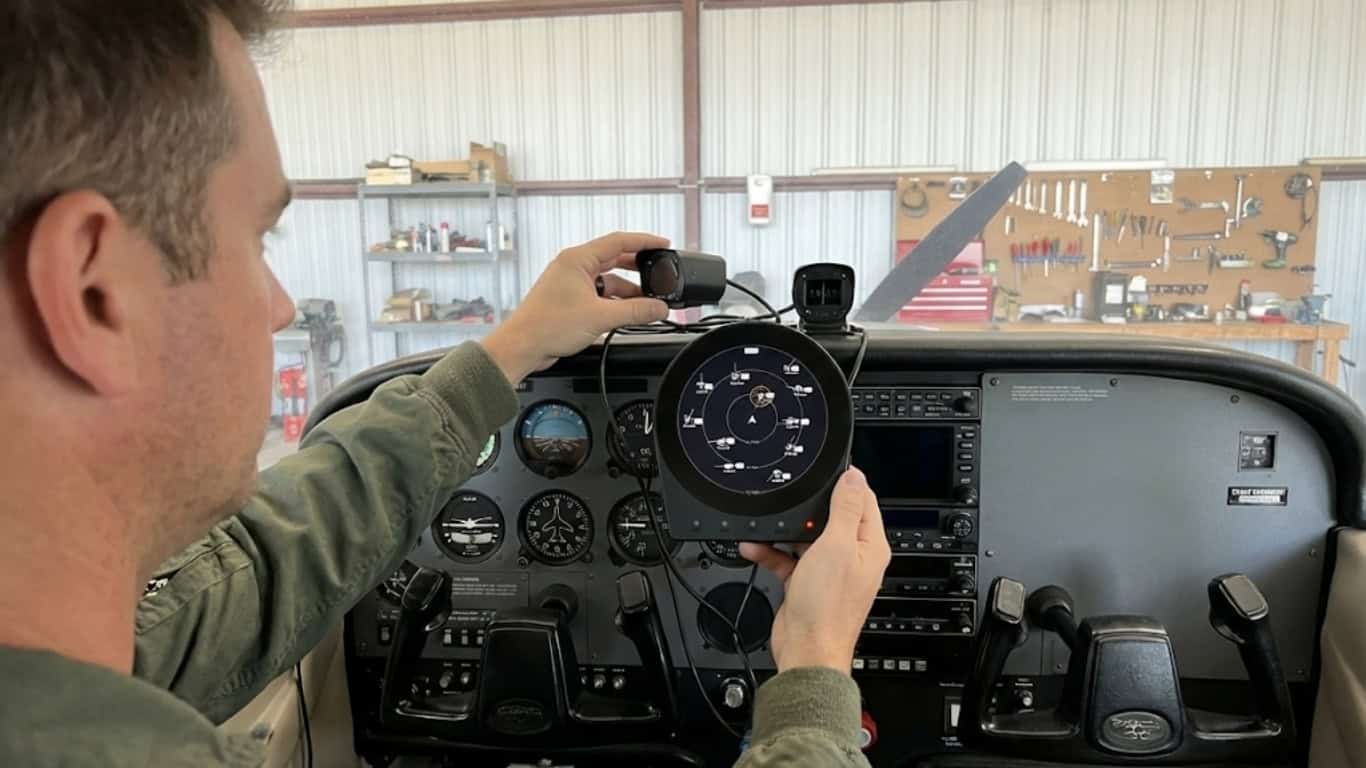
Portable electronic CO monitors require slightly more thought but still need no permanent aircraft modification. Most include mounting accessories like Velcro straps, suction cups, or clips that allow secure positioning without drilling holes or running wires.
Effective portable monitor installation balances three requirements: the display must be visible, the alarm must be audible, and the sensor must sample cabin air effectively. Popular mounting locations include:
Control Yoke Mounting: Clips that attach monitors to the control yoke keep the device directly in your line of sight and ensure alarm audibility. Verify the monitor doesn’t obstruct control movement or instrument visibility.
Glare Shield Mounting: Velcro strips or suction cups can secure monitors to the glare shield, providing good visibility without occupying panel space.
Panel Mounting: Adhesive Velcro attached to unused panel areas allows portable monitor mounting in fixed locations while maintaining removability for charging or use in other aircraft.
**Integrated Multi-Function Devices: Maximum Value**
Newer approaches combine carbon monoxide detection with other essential safety functions. SkyRecon exemplifies this philosophy by incorporating a high-quality electrochemical CO sensor into its portable ADS-B receiver, providing both traffic awareness and carbon monoxide monitoring in one compact unit.
Installing integrated devices like SkyRecon follows the same principles as standalone portable monitors, secure mounting, display visibility, and sensor air access, but delivers dual functionality. This reduces cockpit clutter compared to separate CO detectors and ADS-B receivers while simplifying setup. One device to position, one power source to manage, one piece of equipment to verify operational during pre-flight.
For pilots who need both CO detection and ADS-B traffic/weather capabilities, integrated solutions provide superior value and simplified installation. The mounting considerations remain identical to standalone portable monitors.
**Panel-Mounted Systems: Permanent Integration**
Permanently installed panel-mounted CO monitors integrate into your instrument panel like other avionics, requiring physical installation, electrical connection, and appropriate regulatory approval. This suits aircraft owners planning long-term ownership who want professional-grade detection as permanent equipment.
Panel-mounted installation involves cutting instrument holes (if not already available), routing wiring, connecting to electrical systems through appropriate circuit breakers, and completing required documentation. Most pilots choose professional installation for panel-mounted systems.
Optimal Placement Locations
CO detector placement significantly affects detection effectiveness and practical utility.
**Sensor Location Considerations**
Air Circulation: CO sensors must be positioned where cabin air circulation allows them to sample contaminated air when exhaust intrusion occurs. Locations with good airflow, such as near ventilation outlets, in central cabin areas, or along natural air circulation paths, provide faster detection than stagnant corners.
Breathing Zone: Ideally, sensors should monitor air in the pilot’s breathing zone, approximately head height in the cockpit. This ensures the detector samples the same air you’re breathing, providing warning before dangerous exposure occurs.
Avoid Dead Air Spaces: Don’t place detectors in locations with minimal air movement like behind panels, in cargo areas, or positions blocked by seats or equipment.
Temperature Considerations: Electrochemical CO sensors function across wide temperature ranges but perform optimally at moderate temperatures. Avoid mounting locations subject to extreme heat (directly in sunlight streams) or extreme cold (near drafty windows). Most cockpit locations provide acceptable temperatures.
**Display and Alarm Considerations**
Line of Sight: Position detectors where you can see the display with minimal head movement from normal flight position.
Lighting Compatibility: Consider how detector displays appear in various lighting conditions. Detectors with adjustable backlighting integrate better with panel lighting systems.
Audible Alarm Effectiveness: Verify alarm audibility from normal flight position with headsets on. Test alarm audibility before finalizing installation.
**Practical Access**
Battery Changes and Charging: For battery-operated detectors, ensure the installation allows easy access for battery replacement or charging. Rechargeable devices like integrated ADS-B receivers with CO sensors need accessible USB charging ports.
Testing and Calibration: Some detectors require periodic testing or calibration. Installation should allow access for these procedures without requiring removal or extensive disassembly.
Wiring and Power Requirements
Electronic CO monitors require electrical power from either internal batteries or aircraft electrical systems.
**Battery-Powered Portable Monitors**
Most portable CO monitors operate on standard batteries or rechargeable lithium batteries. Battery-powered operation eliminates wiring requirements but creates battery management responsibilities.
Battery Life Management: Typical battery life ranges from 12 months to several years for primary lithium cells, or several hours for rechargeable units. Establish procedures for checking battery status before flights and replacing or recharging on appropriate schedules.
Rechargeable Options: Monitors with rechargeable batteries, including integrated devices like SkyRecon that combine CO detection with ADS-B reception, require charging discipline. Establish routines such as charging after each flight or overnight before flying. USB charging compatibility allows use of portable battery banks as backup power sources.
The advantage of rechargeable systems is eliminating disposable battery costs while ensuring consistent power availability. Most provide hours of continuous operation, exceeding typical general aviation flight durations.
**Panel-Mounted System Wiring**
Permanent panel-mounted CO monitors connect to aircraft electrical systems, requiring proper wiring installation following aviation standards.
Power Requirements: Most aviation CO monitors operate on standard aircraft voltages (12V or 28V) and draw minimal current (typically 50-150 milliamps).
Circuit Protection: Install appropriate circuit breakers or fuses protecting the CO monitor circuit. Typically 1-2 ampere breakers suffice for standard CO monitors.
Wire Routing: Route power wiring following aircraft wiring practices. Use appropriate wire gauges for current load and wire length. Secure wiring with proper clamps preventing chafing or contact with hot, sharp, or moving components.
Grounding: Proper grounding is critical for reliable monitor operation. Use clean ground points with metal-to-metal contact, avoiding paint or corrosion.
FAA Approval Considerations
Understanding FAA approval requirements prevents regulatory complications and ensures legal operation after installation.
**Experimental and Amateur-Built Aircraft**
Experimental aircraft allow owners to perform virtually any modifications including CO detector installation. No FAA approval is required. Simply install the equipment following good workmanship practices and make appropriate logbook entries.
**Certified Aircraft: Understanding Alterations**
Portable Equipment: Portable CO monitors, including standalone detectors and integrated devices like SkyRecon that combine CO detection with ADS-B reception, require no FAA approval since they involve no permanent aircraft modification. These devices are considered portable electronic equipment similar to tablets or GPS units. No logbook entries, approvals, or paperwork required.
This makes portable solutions ideal for pilots who rent aircraft, fly multiple aircraft, or want immediate CO protection without regulatory complexity.
Minor Alterations: Panel-mounted monitors installed in existing instrument holes typically qualify as minor alterations under 14 CFR Part 43 Appendix A. Minor alterations can be approved and returned to service by A&P mechanics through appropriate logbook entries.
Major Alterations: Installations requiring major alterations need either an STC (Supplemental Type Certificate) or FAA field approval through Form 337. Most straightforward CO detector installations avoid major alteration classification.
**STC Availability**
Some CO monitor manufacturers have obtained STCs for their products in popular aircraft models. When STCs exist for your aircraft, installation follows STC instructions, simplifying the approval process.
Step-by-Step Installation Guide
**Installing Passive CO Detection Cards**
Clean the mounting surface where you’ll place the card. Wipe with alcohol to ensure good adhesion.
Position the card in your chosen location to verify visibility before removing adhesive backing.
Remove adhesive backing and firmly press the card onto the mounting surface for 10-15 seconds.
Document installation noting card brand, installation date, and expiration date.
Add reminder to replace card at expiration (typically 12-24 months).
**Installing Portable Electronic Monitors**
Choose mounting location balancing visibility, alarm audibility, and air sampling access. For integrated devices like SkyRecon, consider both CO sensor access and optimal positioning for ADS-B reception.
Install mounting hardware (Velcro, clips, or suction cups) per manufacturer instructions. Clean surfaces thoroughly before application.
Position the monitor ensuring it’s secure and won’t shift during flight. Verify display visibility.
Test the installation by powering on and verifying proper operation. For integrated devices, confirm both CO detection and other functions work properly.
Establish battery management procedures for checking status and recharging as needed.
Document installation in personal records noting monitor model, serial number, installation date, and sensor expiration date.
**Installing Panel-Mounted Systems (Professional Installation Recommended)**
Select panel location providing visibility and access. Verify adequate depth behind the panel.
Cut the instrument hole if necessary using proper tools.
Route power wiring from circuit breaker to monitor location following aircraft wiring practices.
Install circuit breaker of appropriate rating in accessible location.
Connect ground wire to a clean, secure ground point.
Mount the monitor in the panel hole per manufacturer instructions.
Connect power and ground following wiring diagram.
Test the system by applying aircraft power and verifying operation.
Complete documentation including logbook entries and Form 337 if required.
Professional vs. DIY: Making the Choice
Choose DIY installation for:
Passive detection cards (30-second installation)
Portable electronic monitors (5-10 minute setup)
Integrated portable devices like SkyRecon
Experimental aircraft installations
Choose professional installation for:
Panel-mounted systems in certified aircraft
Complex wiring requirements
When you lack confidence in your installation skills
Professional installation typically costs $200-500 for labor, ensuring proper workmanship, correct documentation, and regulatory compliance.
However, for most general aviation pilots, portable solutions, whether standalone CO monitors or integrated devices combining multiple safety functions, provide optimal combination of effectiveness, simplicity, and value. No installation complexity, no regulatory approvals, immediate protection, and portability between aircraft makes portable CO detection the practical choice.
Conclusion
Carbon monoxide detector installation need not be complicated or expensive. From simple passive cards requiring 30 seconds to install, to portable monitors taking minutes to mount, to integrated devices like SkyRecon that combine CO detection with ADS-B traffic awareness, to permanent panel-mounted systems, options exist for every aircraft type, budget, and skill level.
The most important decision isn’t choosing between DIY and professional installation, it’s choosing to install CO detection at all. Whether you affix a $10 passive card or invest in an integrated safety device providing both CO protection and traffic awareness, you’ve taken the critical step toward carbon monoxide protection. The installation method matters far less than having working detection equipment ready to warn you when exhaust system failures threaten your safety.
For pilots seeking maximum value, integrated portable solutions deliver comprehensive safety capabilities in simple, no-installation packages that provide protection across all aircraft you fly. This approach represents the future of general aviation safety equipment, combining multiple essential functions while maintaining the simplicity and portability that general aviation demands.
Learn more about carbon monoxide detection in general aviation, symptoms of CO poisoning, and FAA requirements in our comprehensive guide series.