You climb aboard your trainer aircraft just before first light. Frost still clings to the wings. Your flight plan: Toulouse to Basel, a cross-border hop of about 400 nautical miles. You check the weather; visibility, wind, and temperature all look good. You plug in your tablet, strap your SkyRecon device to the glare shield, and taxi out.
Airborne, everything seems routine. But as you pass near the foothills of the Pyrenees, aircraft start disappearing from your ADS-B display. Not because they're gone, but because many aren't broadcasting ADS-B Out. Through your SkyRecon feed, you see them appear via FLARM, OGN trackers, FANET data, and reports from other pilots using the SafeSky network. That expanded view lets you anticipate converging traffic you'd otherwise be completely blind to.
In Europe's airspace, populated by a patchwork of aircraft types and disparate equipage standards, multi-source traffic data isn't just useful. It's a safety multiplier. This is the core concept behind supplemental traffic sources that go beyond ADS-B alone.

SkyRecon with SafeSky Inside: Multiple Data Sources
SkyRecon's portable ADS-B receiver with SafeSky inside aggregates traffic awareness data from many different sources, not just pure ADS-B:
ADS-B / Mode S: Aircraft broadcasting position information on 1090 MHz (and where available, UAT/978 MHz) are a core source. SkyRecon picks up these from both radio receivers and SafeSky's ground station network.
FLARM: Gliders, sailplanes, and some powered aircraft use FLARM as a collision avoidance system. SafeSky integrates FLARM traffic to show non-ADS-B aircraft climbing in thermal columns or gliding across valleys.
FANET: Used in paragliding and paramotor communities for local peer traffic; when integrated, it feeds SafeSky visibility of free flight types.
Open Glider Network (OGN): A free-flight tracker network providing positions for unpowered aircraft.
Pilot-aware and eConspicuity devices: Pilots using PilotAware, PowerFLARM, SkyEcho, or other GDL90-compatible units feed traffic into the SafeSky system, adding "flying stations" to the network.
Mobile/multi-pilot telemetry: Pilots using the SafeSky app share their position via mobile internet; ground stations help bridge gaps where airborne mobile coverage exists.
Ground stations: SafeSky supports a network of ground-based receivers relaying radio, ADS-B, and Mode-S data overhead to the SafeSky server.
SafeSky provides traffic awareness from more than 30 sources, creating a traffic picture far richer than any single technology can deliver.
Where ADS-B Alone Falls Short
Real examples illustrate the gaps:
A study of glider traffic in southeastern France (near Marseille and Salon-de-Provence) collected data between 15-30 June 2022 using ADS-B and FLARM receivers. Many glider tracks were only visible via FLARM. ADS-B didn't pick them up at all.
A pilot flying at roughly 3,000 feet in rural Western Ireland reported that ADS-B coverage was spotty, but SafeSky remained active, showing multiple aircraft absent from ADS-B feeds.
SafeSky has an approximately 80% success rate for transmitting data up to 5,000 feet above ground level. In most of the coverage area, mobile and internet-based data works well, especially for flights in lower airspace.
These examples show that many aircraft, especially gliders, microlights, experimentals, and older piston aircraft, may be invisible in pure ADS-B feeds but show up in SafeSky via FLARM or peer-shared networked feeds. This is part of the broader electronic conspicuity ecosystem that European aviation is building toward.
How SkyRecon and SafeSky Work Together in Flight
Flying with SkyRecon with SafeSky Inside, you get a built-in display that blends ADS-B and SafeSky network traffic. Even without your tablet, you see nearby aircraft from all these sources.
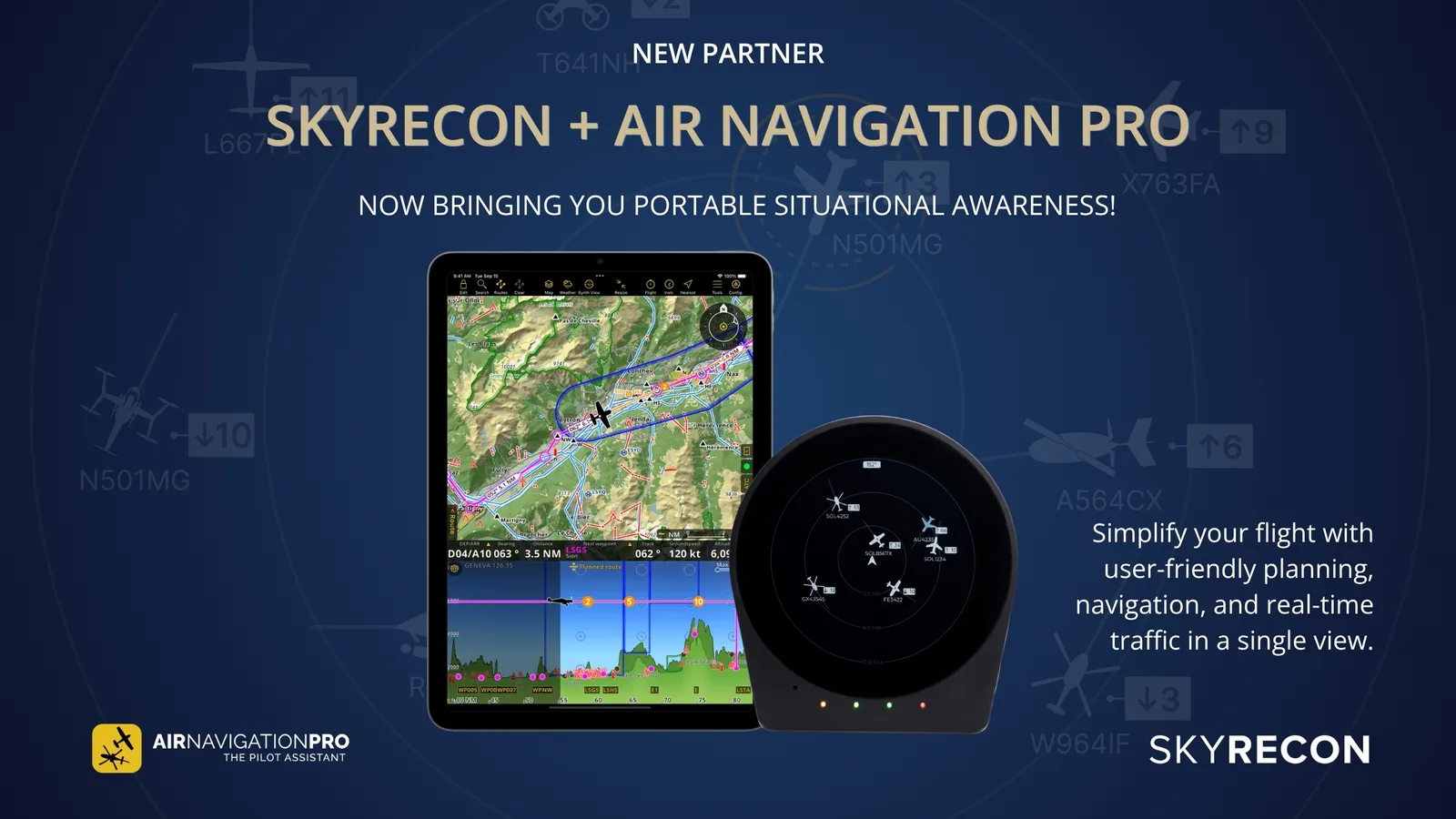
When SkyRecon is connected to your iPad or tablet, ForeFlight, SkyDemon, EasyVFR, and similar apps overlay this combined traffic layer (ADS-B plus SafeSky) onto their maps. You see aircraft symbols for ADS-B Out aircraft and non-ADS-B traffic picked up via SafeSky, all on your navigation app.
The result is a much fuller "traffic tapestry." Where ADS-B might show five aircraft in a region, SafeSky might show ten, adding gliders, paragliders, or non-certified aircraft that fly under ADS-B radar.
More aircraft visible means more time to see and avoid. You become aware of traffic earlier (which ADS-B alone would miss) and can plan ahead: level changes, avoiding thermal columns, giving wider berth to uncontrolled airports with mixed traffic. This is especially valuable in cross-border or rural sections where ground radar and ADS-B reception are weak.
What The Statistics Say
EASA reports that across its Member States, there are on average 6 fatal airborne collisions per year, with approximately 13 lives lost annually, many involving GA aircraft. Better "see and be seen" through electronic visibility for all participants is one of the primary strategies to reduce those numbers.
In Finland, near-miss and airprox reports have increased: in 2024 there were 68 near-misses involving aircraft, above the 10-year average of roughly 41. GA and recreational aviation accounted for 18 such incidents alone, many in uncontrolled airspace. Visibility gaps contribute heavily to these numbers.
SafeSky reports having over 75,000 pilots using its app and network in Europe. That scale means substantial peer-sharing of position data, which amplifies visibility rapidly as more aircraft join.
These numbers confirm that visibility gaps are not theoretical. They happen often, and multi-source awareness can help reduce the risk.
Why This Layered Approach Matters for You
Cross-border flights: As you fly from one country to another, data standards, mobile coverage, ADS-B receiver density, and regulation can vary. Multi-source systems smooth over those transitions.
Rural or mountainous terrain: ADS-B and ground radar may suffer from line-of-sight limitations; SafeSky's ground network plus mobile sharing plus FLARM often succeed where ADS-B signal strength drops.
Mixed equipage airspace: If you share skies with gliders, ultralights, or legacy aircraft, many won't have ADS-B Out. Without non-ADS-B sources, you simply won't see them on ADS-B displays.
Earlier detection, more reaction time: The earlier you become aware of traffic (especially non-broadcasting aircraft), the more time you have to alter course or altitude to maintain safe separation. As one pilot's close call illustrates, those extra seconds of warning can be the difference between a routine flight and a dangerous near miss.
A Cross-Border Flight Example
Returning to that Toulouse-to-Basel flight:
You depart Toulouse and climb to 4,500 feet. ADS-B shows several VFR prop aircraft in the vicinity. Over France's southern interior, you pass near several glider operations. ADS-B shows nothing of them, but SafeSky shows FLARM and OGN gliders on your right climbing near thermals. You adjust your flight path slightly to avoid them.
Crossing into Switzerland, you lose ADS-B ground receiver coverage near a mountainous pass. SafeSky's ground stations and mobile data keep you informed of other traffic: powered ultralights, drones in restricted zones. As you approach Basel and mix with controlled airspace, you have both ADS-B Out certified aircraft and non-certified ones visible. Safe separation maintained because your combined traffic picture is richer than what ADS-B alone could show.
SkyRecon shows both SafeSky data and ADS-B, and ForeFlight or SkyDemon overlays it on your moving map. Your situational awareness remains high throughout. For pilots considering why portable ADS-B is the smart choice, this multi-source capability is a key reason.
More Sources, Safer Skies
In Europe's diverse and evolving GA landscape, seeing the bigger picture isn't optional. Reliance on only ADS-B or only visual scanning leaves gaps. SafeSky plus SkyRecon's multi-source approach fills those gaps with real-time data from FLARM, OGN, FANET, peer telemetry, Mode-S, and more.
If you fly cross-borders, in mixed equipage airspace, in rural terrain, or with aircraft that aren't universally ADS-B Out equipped, investing in SkyRecon with SafeSky Inside gives you that crucial extra visibility. Often in seconds that matter.
Explore SkyRecon's multi-source features