
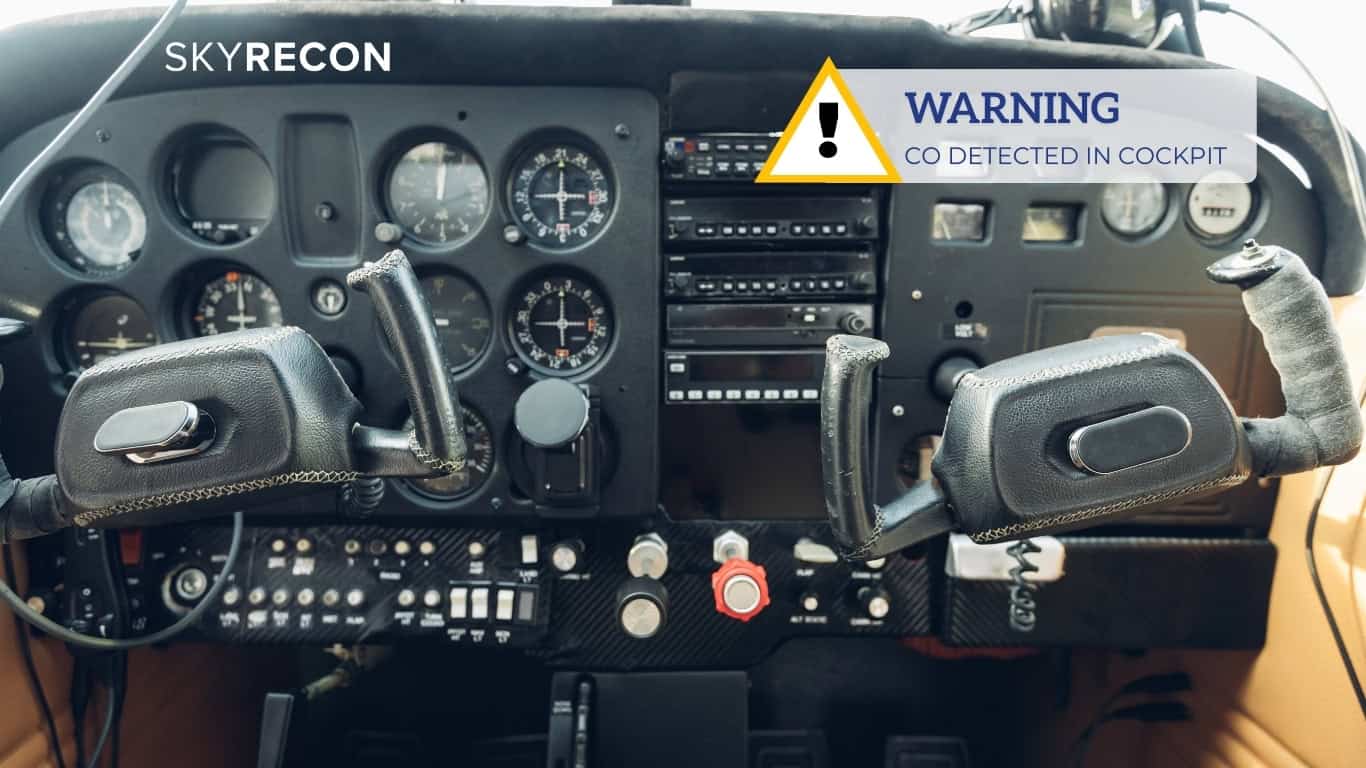
You cannot smell it. You cannot see it. By the time you feel the first symptom (a dull headache, a vague fatigue, a mild difficulty concentrating), your cognitive function may already be affected.
Carbon monoxide is one of the most underestimated risks in general aviation. It is present in the same aircraft where you are reading charts, talking to ATC, and trusting your instruments to keep you and your passengers safe. And for the majority of GA pilots, the only protection currently carried is a passive colour-change card that requires them to look at it, correctly interpret it, and act on it, at exactly the moment they may be least capable of any of those things.
This is why a portable ADS-B receiver with CO detection capabilities represents a meaningful step forward in practical cockpit safety.
The Carbon Monoxide Detection Aviation Data Nobody Talks About Enough
The statistics around carbon monoxide detection aviation risk in GA are not widely publicised, but they are significant.
The NTSB identified 31 aircraft accidents directly attributed to CO poisoning between 1982 and 2020. Twenty-three of those accidents were fatal, killing 42 people and seriously injuring four more. In virtually every one of those fatal accidents, no CO detection device with active alerting was present in the aircraft.
The true scale of the problem is almost certainly larger. CO dissipates rapidly after a crash, and toxicology testing is only performed in fatal accidents where a blood sample can be obtained post-mortem. Analysis of fatal US aircraft accidents between 1967 and 1993 found that at least 360 victims had been exposed to sufficient CO to impair their abilities before or during the event. These are incidents where CO may have been a contributing factor that was never formally attributed, because the evidence had dissipated before investigation.
Despite this documented record, the FAA does not currently require CO sensors in enclosed-cabin GA aircraft with reciprocating engines. The NTSB first recommended mandatory active CO alerting in 2004 and made the same recommendation again in 2022, specifically stating that passive colour-change devices are insufficient and that active audible and visual alerting is required for the alert to be effective.
How CO Gets Into Your Cockpit
The primary pathway for CO in a piston GA aircraft is the cabin heat system. In aircraft of the Cessna 172, Piper PA-28, and equivalent generation (which make up the vast majority of the GA training and touring fleet), cabin heat is generated by routing fresh air over the exhaust muffler shroud before feeding it into the cockpit. A crack in the muffler wall, a deteriorated exhaust joint, or a failed seal allows combustion gases to mix with the heated air entering the cabin.
What makes this particularly dangerous is the absence of any detectable odour. The exhaust leak often forms internally within the shroud assembly, where gases mix with airflow before any hydrocarbon smell reaches the occupants. The CO arrives feeling exactly like warm cabin air. Nothing appears on the instruments. Nothing smells wrong. The pilot feels nothing unusual, until, at some point, they feel tired.
At altitude, where CO exposure symptoms (fatigue, mild headache, difficulty concentrating) mirror those of hypoxia, accurate self-diagnosis becomes nearly impossible. CO concentrations of 10-20% in the bloodstream cause confusion, impaired judgment, and difficulty concentrating. At higher concentrations, the risk of incapacitation increases significantly. In documented NTSB cases, pilots were found at 28-37% CO blood saturation at the time of their accidents, levels that would have been producing severe cognitive impairment throughout the final stages of the flight.
Why Your Cockpit CO Sensor Needs to Be Active
A passive colour-change detector requires the pilot to look at it, recognise the colour has changed, and connect that observation to action. This is a reasonable process when you are fully alert and functioning normally. It is an unreliable process when the substance you are detecting may already be reducing the cognitive capacity you need to perform those exact steps.
An active cockpit CO sensor monitors continuously and alerts through an audible alarm, one that commands attention regardless of what you are doing. Whether you are head-down on an instrument approach, running a pre-landing checklist, or talking through a complex clearance, the alarm cuts through. The NTSB's 2022 recommendation was explicit on this point: the alert must be active, audible, and visual, not passive, not silent, not dependent on the pilot looking at the device.
SkyRecon's built-in CO sensor does exactly this. It monitors cabin air continuously and triggers an audible alarm alongside an on-screen visual alert when CO levels rise above a user-configurable threshold. It is integrated directly into the device: no separate hardware, no second cable, no additional item in your pre-flight scan to worry about.
SkyRecon's CO sensor is not a certified CO detector and should not be relied upon as a primary safety device. CO alert thresholds are user-configurable and may not reflect official safety standards. SkyRecon's CO monitoring is a supplementary awareness layer. Always carry a certified CO detector as your primary protection and follow standard aviation safety procedures. With that caveat firmly in place, having continuous active electronic monitoring that alerts audibly when levels rise is a meaningful step up from the passive card carried by most GA pilots today.
Two Threats. One Device. Act on Both.
A portable ADS-B receiver with CO detection addresses two of the most underestimated risks in GA simultaneously: the traffic you cannot see and the gas you cannot smell. One device, no installation, no modification to your existing cockpit setup.
Paired with a certified CO detector as your primary CO safety measure, SkyRecon's sensor adds an always-on electronic awareness layer that passive devices simply cannot replicate. And because it sits in the same unit already managing your traffic picture (including multi-source electronic conspicuity data), it adds that protection without adding clutter, weight, or complexity to the cockpit.
For the full picture of what SkyRecon offers, including multi-source traffic fusion, integrated display, and EFB connectivity, return to our guide on the best portable ADS-B receiver for general aviation.
Get in touch to learn more about SkyRecon and active CO alerting in the cockpit.