
You are established on a cross-country leg. Skies are clear, and your EFB is showing a reassuringly quiet traffic picture. Ten miles ahead, a glider is thermalling silently at your altitude. No transponder. No ADS-B Out. Completely invisible on your screen. You do not see it until it fills your windscreen. This scenario plays out in uncontrolled airspace every day, and it is precisely the gap that choosing the best portable ADS-B receiver for general aviation is designed to close.
General aviation is in the middle of a quiet safety revolution. Real-time traffic awareness, cockpit environmental monitoring, seamless EFB integration: technology once limited to commercial flight decks is now accessible to every pilot in a device that fits in a flight bag and requires no installation. But not all portable receivers are equal. Some show you a partial traffic picture and call it complete. Others require you to manage multiple devices, multiple cables, and multiple subscriptions to replicate what the best single-unit solutions deliver out of the box.
This guide covers how ADS-B In works, what separates a basic receiver from a genuinely comprehensive safety device, how multi-source traffic fusion changes the picture, what the data says about cockpit CO risk, how EFB integration works, and what to look for when making your decision. If you fly a GA aircraft of any kind, certificated, experimental, ultralight, or rented, this guide is for you.
What Is a Portable ADS-B Receiver and Why Do GA Pilots Need One?
Automatic Dependent Surveillance-Broadcast (ADS-B) is a surveillance technology in which an aircraft continuously broadcasts its GPS-derived position, altitude, and velocity to any receiver within range. There are two sides to the system. ADS-B Out is your aircraft transmitting its position to the world. ADS-B In is your aircraft receiving the positions of others. A portable ADS-B receiver provides the In function. It listens for surrounding traffic and either displays it on its own screen or passes it to your EFB app via a standardised data connection.
The FAA mandated ADS-B Out by 1 January 2020 for operations in Class A, B, C, and most Class E airspace. As of July 2024, the FAA could detect over 105,000 fixed-wing GA aircraft equipped with rule-compliant ADS-B Out. That represents real progress from the mandate era. But the figure also illustrates the scale of what remains: the GA fleet in the US alone numbers well over 200,000 registered aircraft, and the ADS-B Out mandate contains explicit exemptions that leave a significant portion of the active flying population transmitting nothing.
Aircraft not certificated with an electrical system, including many gliders, balloons, and lighter-than-air craft, are entirely exempt from the ADS-B Out rule. Aircraft that fly exclusively below the mandated airspace floor have no legal obligation to transmit. Ultralights operating under FAR Part 103 are not required to carry any transponder or ADS-B equipment at all. And in Europe, where no equivalent mandate exists for light GA, the unequipped population is substantially larger still.
This matters because ADS-B In traffic awareness, at its most basic level, only shows you aircraft that are already transmitting ADS-B Out. If an aircraft is not transmitting, it does not appear on your display, regardless of how good your receiver is. For GA pilots who fly in uncontrolled airspace, at lower altitudes, near training areas, or in European airspace, this is not a theoretical gap. It is a daily operational reality.
The case for a portable device, rather than a permanently installed one, is equally strong. A portable receiver requires no avionics shop visit, no STC approval, no permanent wiring, and no modification to the aircraft. It mounts in your cockpit with the included accessories (a suction-cup window mount or a 1/4-inch screw-mount adapter), powers from a built-in rechargeable battery, and is operational from the moment you switch it on. For pilots who fly rented aircraft, operate multiple airframe types, fly in clubs, or own experimental and ultralight machines with limited panel space, portability is not a convenience. It is the only practical option.
How ADS-B In Works: The Technology Behind Your Traffic Picture
To make an informed decision about which portable ADS-B receiver for general aviation suits your flying, it helps to understand exactly what the technology does and where it stops.
ADS-B operates on two frequencies. 1090 MHz Extended Squitter (1090ES) is the international standard, used by all commercial aviation worldwide and by GA aircraft operating above FL180 or internationally. 978 MHz Universal Access Transceiver (UAT) is a US-specific standard designed for lower GA airspace, and additionally carries FIS-B weather uplinks from FAA ground stations. A well-specified portable receiver should receive on both frequencies. SkyRecon's built-in ADS-B antenna picks up both 1090MHz and 978MHz simultaneously, ensuring the broadest possible radio-sourced traffic picture from a single device.
In the US, the FAA further supplements the direct air-to-air ADS-B picture with Traffic Information Service-Broadcast (TIS-B). Ground stations detect aircraft carrying Mode-C and Mode-S transponders and rebroadcast their derived positions to nearby ADS-B In receivers. This allows your receiver to see some transponder-equipped aircraft that have not installed ADS-B Out, a meaningful improvement in coverage. TIS-B is ground-station-dependent, though. It degrades significantly in mountainous or remote terrain and provides no coverage whatsoever for aircraft carrying no transponder or electronic conspicuity device at all.
The Invisible Traffic Problem: Who You Are Not Seeing
Even with 1090ES reception, UAT reception, and TIS-B combined, a radio-only portable receiver will miss a substantial portion of the aircraft sharing your airspace:
Gliders and motorgliders represent one of the largest blind spots in popular GA airspace. European gliders overwhelmingly use FLARM, a dedicated short-range anti-collision system operating on 868 MHz, rather than ADS-B Out. FLARM is standard equipment in gliding clubs across the UK, Germany, France, Austria, and Switzerland. A radio-only ADS-B receiver is completely deaf to it.
Paragliders, hang gliders, and paramotors have growing adoption of FANET, a peer-to-peer networking system designed for non-powered and light-powered aircraft. FANET traffic is invisible to any device that cannot access internet-sourced data aggregation, regardless of how good the radio hardware is.
Microlights and ultralights operating in Class G airspace face no transponder or ADS-B mandate in many jurisdictions. They are flying legally, in the same low-level airspace you use for cross-country and circuit training, with zero electronic visibility.
Military and government aircraft operating under ADS-B exemptions present a specific, well-documented, and recently high-profile risk. The January 2025 collision near Washington DC brought renewed attention to this problem: the Army helicopter involved had its ADS-B Out switched off under a national-security exemption, making it invisible to any standard receiver.
Drones operating at low altitude and below radar coverage are an increasingly significant presence in the same uncontrolled airspace where GA operates, and they carry no ADS-B Out obligation in most jurisdictions.
Understanding this invisible traffic population is the first and most important step toward understanding why the best portable ADS-B receiver for general aviation must go further than radio reception alone.
Multi-Source Data Fusion: What Separates Good from Great
The defining feature that separates a standard portable receiver from the best portable ADS-B receiver for general aviation is multi-source data fusion. This is not a marginal technical improvement. It is a fundamentally different approach to traffic awareness, and it changes the safety picture substantially.
Standard portable receivers are radio-only. They hear what is within RF range on the frequencies they support, and nothing else. In ideal conditions, with a dense population of ADS-B Out-equipped aircraft, this provides a reasonable traffic picture. In the mixed-equipage, low-altitude, uncontrolled airspace where GA collision risk is highest, it leaves dangerous gaps.
SafeSky Inside is the technology that powers multi-source fusion in SkyRecon. Rather than relying solely on what the device's radio can hear, SafeSky Inside connects to a cloud-based traffic aggregation network that pulls data from over 30 traffic sources simultaneously. These sources include:
- ADS-B via ground station networks, supplementing direct radio reception
- FLARM, the dominant anti-collision technology in European gliders and light aircraft
- FANET, used by paragliders, hang gliders, and paramotors
- OGN (Open Glider Network), a crowd-sourced European ground station network
- Mode-S MLAT (multilateration), deriving positions from non-ADS-B transponders
- PilotAware and other regional electronic conspicuity networks
- Community position data from over 75,000 active pilots sharing their location in real time
The practical result is that your cockpit display shows traffic that would be completely invisible to a radio-only device. The glider thermalling at your altitude five miles ahead. The paramotor joining the circuit at the airfield you are approaching. The microlight operating VFR in Class G without any transponder. The military helicopter flying with its ADS-B switched off. These appear on your display as alert targets, giving you time to look, deviate, and make a traffic call before the situation demands a sudden manoeuvre.
To access SafeSky Inside's internet-sourced traffic layer, SkyRecon requires an internet connection. You can provide this by tethering to your smartphone's Wi-Fi hotspot, or with the SkyRecon Data+ variant, which includes a SIM card tray for you to insert your own data SIM, providing always-on connectivity independent of your handset. In standalone mode, without an internet connection, SkyRecon continues to display all locally received ADS-B traffic on its built-in screen.
For a deeper understanding of exactly what a radio-only ADS-B receiver misses, and how SafeSky Inside bridges the gap, read our dedicated guide on the portable ADS-B receiver for traffic awareness.
The Integrated Display: Cockpit Awareness Without a Tablet
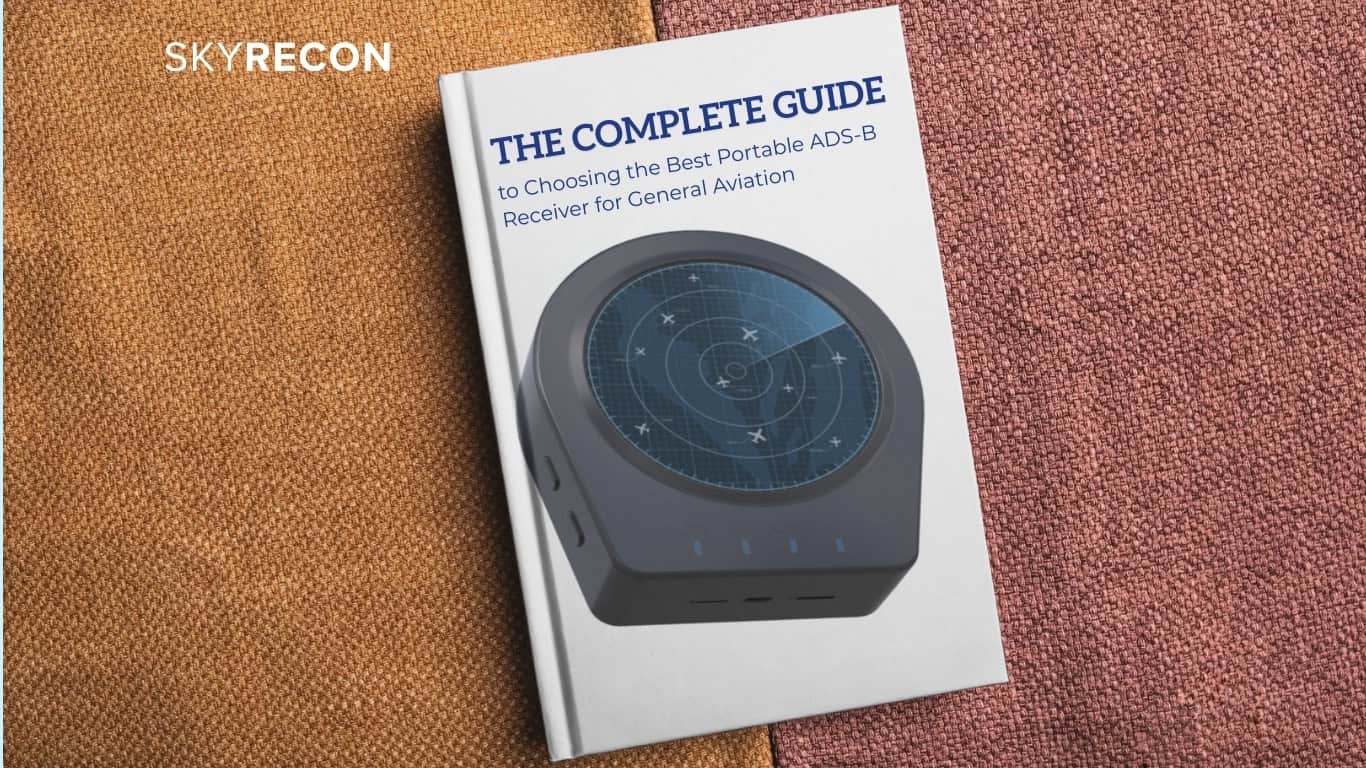
One of the most practically significant features of SkyRecon, and a feature that distinguishes it from most portable receivers on the market, is its round 3.4-inch LCD screen.
Most portable ADS-B receivers are headless. They receive traffic data and pass it to a tablet or smartphone running an EFB application. This is functional, but it creates a dependency: your traffic picture is only visible when your tablet is on, unlocked, displaying the right app, and mounted where you can see it. During approach, in a pattern with multiple aircraft, or in IMC, managing a tablet while also monitoring traffic is a workload the dedicated display eliminates entirely.
SkyRecon's round 3.4-inch LCD screen displays surrounding traffic relative to your position in real time, with advanced traffic filtering and adjustable zoom to focus on the traffic that matters most at any given phase of flight. It features auto-brightness to ensure readability in varying light conditions. This means SkyRecon can be used entirely as a standalone device, no tablet required, or paired with your EFB for a dual-display setup where your navigation app continues to show route and airspace information while SkyRecon handles the dedicated traffic picture.
For pilots in aircraft where panel space is limited, where a tablet mount would be impractical, or who simply want the cleanest possible cockpit setup, an integrated screen is not a nice-to-have. It is the feature that makes the whole system genuinely usable in the real world.
CO Monitoring: The Silent Risk in Your Cockpit
A truly comprehensive cockpit safety device does more than track traffic. SkyRecon integrates a continuous Carbon Monoxide (CO) sensor with audible and visual alerts, addressing a hazard that kills GA pilots every year and that the vast majority of pilots are inadequately protected against.
CO is colourless, odourless, and tasteless. It is produced by any incomplete combustion process, including your aircraft's piston engine. In older GA aircraft, and most of the GA fleet is old, cracked mufflers, corroded exhaust pipes, and poorly sealed firewalls can allow exhaust gas to enter the cabin without any detectable smell. The CO arrives as a silent, invisible component of air that simply feels warm.
The NTSB identified 31 aircraft accidents directly attributed to CO poisoning between 1982 and 2020. Twenty-three of those accidents were fatal, killing 42 people and seriously injuring four more. In virtually every one of those fatal cases, no CO detector with active alerting was present in the aircraft. The NTSB has been recommending mandatory CO detection with active alerting in GA aircraft since 2004, and reiterated that recommendation in 2022.
SkyRecon's built-in CO sensor monitors cabin air continuously and triggers an audible alarm and on-screen visual alert when CO levels rise above the configured threshold, providing an earlier opportunity to take corrective action. SkyRecon's CO sensor is not a certified CO detector and should not be relied upon as a primary safety device. CO alert thresholds are user-configurable and may not reflect official safety standards. SkyRecon's CO monitoring is designed as a supplementary awareness layer. Always carry a certified CO detector as your primary CO safety measure and follow standard aviation safety procedures.
With that caveat clearly in place, having an active electronic CO sensor that triggers audibly the moment levels rise is a significant improvement over the passive colour-change cards that most GA pilots currently rely on, cards that require you to remember to look at them at exactly the moment you may be least capable of doing so.
For a full breakdown of CO risk in GA aircraft and why active detection matters, read our guide on the portable ADS-B receiver with CO detection.
EFB Integration: Getting Traffic Into the App You Already Use
A portable receiver is only as useful as its ability to feed data into your navigation workflow without forcing you to change it. The universal standard for this is GDL90, a binary data-link protocol that has become the common language between portable aviation hardware and EFB software across the industry.
GDL90 compatibility is built into every major EFB application: ForeFlight, SkyDemon, EasyVFR, WingX Pro, iFly GPS, FltPlan Go, AvPlan, and more. When SkyRecon outputs GDL90 over Wi-Fi, your existing EFB receives the full traffic data stream and overlays it automatically on your moving map. No proprietary app. No new learning curve. No changes to the workflow you already fly with.
ForeFlight users see SafeSky Inside traffic, including FLARM, FANET, OGN, and all other multi-source data, on their ForeFlight sectional chart, displayed as standard traffic symbols identical to any other traffic source ForeFlight supports. SkyDemon users see the same on their SkyDemon VFR chart. The traffic picture is richer, but the interface is the one you already know.
SkyRecon operates as both a Wi-Fi access point and a Wi-Fi client simultaneously. This means it can connect to your phone's hotspot for internet access while simultaneously broadcasting its own network for your tablet to connect to for GDL90 data. The whole system works on a single device with no external hardware beyond your existing phone and tablet.
For complete step-by-step connection instructions for both ForeFlight and SkyDemon, see our dedicated guide on the portable ADS-B receiver for ForeFlight.
Who Is SkyRecon Built For?
One of SkyRecon's genuine strengths is its breadth of applicable use cases. It is not a device with a narrow target audience.
Private pilots flying certificated aircraft get real-time traffic awareness beyond what ADS-B alone can show, CO monitoring as an additional safety layer, and EFB integration that enriches the navigation tools they already use. All in a device they can move between aircraft freely.
Student pilots and flight schools benefit from the visual traffic display that builds situational awareness from the very first lesson. Instructors flying with students in confined training areas (where multiple aircraft are operating simultaneously at low altitude) get a dedicated traffic screen that does not require interrupting the lesson to manage. The CO monitoring also protects instructors who fly multiple hours per day in ageing training aircraft.
Flying clubs and shared aircraft benefit from a device that is portable and battery-powered. It is easy to share across the fleet without expensive installation work and without any aircraft modification. Every club member uses the same device, in any club aircraft, on every flight.
Experimental and ultralight pilots get a full traffic and CO awareness solution in a self-contained device that requires no installation, no approval pathway, no wiring, and no drain on a minimal aircraft electrical system. For a full exploration of this use case, read our guide on the portable ADS-B receiver for ultralight aircraft.
Choosing the Right Device: The Criteria That Matter
When evaluating any portable ADS-B receiver for general aviation, apply these criteria honestly:
Traffic coverage depth: Does the device receive only ADS-B, or does it fuse multiple data sources (FLARM, FANET, OGN, community data) to show the traffic that radio alone cannot capture? In mixed-equipage airspace, this is the single most important differentiator.
Integrated display: Does it have a dedicated round 3.4-inch LCD screen for eyes-up traffic awareness without depending on a tablet, or does it require an external device for every display function?
GDL90 output: Does it stream traffic to your existing EFB via the standard GDL90 protocol, or does it lock you into a proprietary application?
CO monitoring: Is cockpit CO detection integrated with active audible and visual alerting, or is that a separate device with a separate power requirement? Remember that SkyRecon's CO sensor is supplementary. Always carry a certified CO detector as your primary protection.
Independent internet connectivity: Does it rely solely on your phone's signal for internet-sourced traffic, or does it offer a SIM card tray (as the Data+ variant does) for always-on coverage independent of your handset?
Battery life: Does it offer up to 8 hours of continuous use from a built-in rechargeable battery, making it genuinely standalone for a full flying day without drawing from the aircraft electrical system?
Simplicity of setup: Does it require complex configuration, or is it genuinely ready to fly straight out of the box? Unbox, charge, mount, connect.
Subscription model: Are you paying monthly for basic safety data, or is traffic access bundled into the hardware price? For early adopters, SkyRecon includes lifetime SafeSky Inside access with the hardware.
SkyRecon: Where All of These Criteria Come Together
SkyRecon is a proud member of the ADS-L Coalition, supporting EASA's push for wider electronic conspicuity adoption across GA. For pilots operating in European airspace who care about the broader safety ecosystem, this is a meaningful signal.
The device itself is the product of a straightforward premise: that GA pilots should not have to choose between capability and simplicity, or between safety and portability. SkyRecon brings together a built-in ADS-B receiver on 1090MHz and 978MHz, SafeSky Inside multi-source fusion from 30+ networks, a round 3.4-inch integrated LCD traffic display, a built-in CO sensor with active alerting (supplementary, not certified), GDL90 Wi-Fi output for seamless EFB integration, up to 8 hours of battery life, and a SIM card tray in the Data+ variant for independent internet access. One portable device. No installation. Ready to fly in minutes.
For early adopters, lifetime SafeSky Inside access is included. No monthly fee for the traffic data that makes the whole system work.
Take Command of Your Cockpit Safety
The mid-air collision risk in uncontrolled airspace is not going away on its own. Neither is the CO poisoning risk in older piston aircraft. The technology to address both threats simultaneously is now available in a single portable device, without a permanent installation, without a subscription, and without adding complexity to your cockpit.
SkyRecon delivers a level of traffic and environmental awareness that was simply unavailable in a self-contained portable format until now. First shipments are planned for 2026; get in touch to learn more about the device and our early-pilot programme.